Riffat Hasan and the Quest for Gender Justice in Islam.
DOI:
https://doi.org/10.61815/alibrah.v10i2.740Keywords:
Qur'anic Feminism, Critical Study, Gender Equality, Riffat Hasan, Interpretation MethodologyAbstract
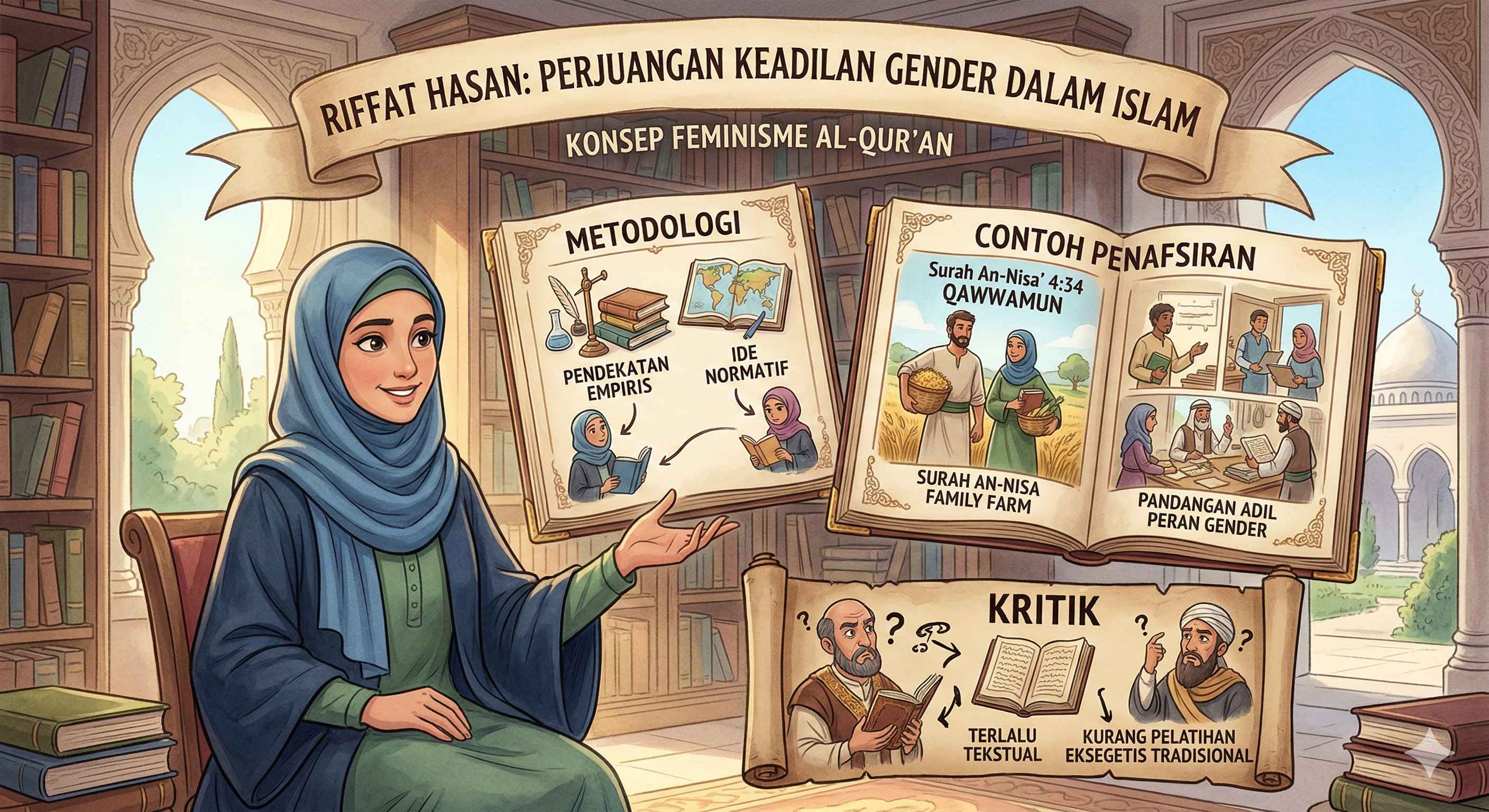
This article critically examines the concept of Qur'anic feminism through the lens of Riffat Hasan's views on gender equality. The discussion focuses on three key areas: first, Hasan's methodological approach to interpreting verses related to feminism; second, examples of his interpretation of these verses; and third, a critique of his interpretive methodology. Utilizing a descriptive qualitative approach rooted in library research, this study draws on various texts, manuscripts, and literature relevant to the topic. The findings reveal that: (1) Riffat Hasan adopts an empirical and idea-normative approach to interpret verses, aiming to challenge conventional readings; (2) Hasan's interpretation of the term Qawwamun in Surah al-Nisa' 4:34 suggests that the role of financial provider is not limited to men, thereby promoting a more equitable view of gender roles; and (3) Hasan’s interpretations have been critiqued for a lack of traditional exegetical training, leading his approach to sometimes be seen as overly textual and lacking depth in interpretive method. This study contributes to the ongoing discourse on gender equality within Islamic thought by analyzing Hasan’s work and its implications for modern interpretations of gender roles in the Qur'an.
Downloads
References
Afsaruddin, Asma. "Hermeneutics and Honor: Negotiating Female 'Public' Space in Islamic/ate Societies." In Gender, Politics, and Islam, edited by Therese Saliba, Carolyn Allen, and Judith A. Howard, 58. Chicago: University of Chicago Press, 2005.
Ahmed, Leila. Islamic Feminism and Beyond. New York: Cambridge University Press, 2011.
Ahmed, Leila. Women and Gender in Islam: Historical Roots of a Modern Debate. New Haven: Yale University Press, 1992.
Ali, Kecia. Sexual Ethics and Islam: Feminist Reflections on Qur'an, Hadith, and Jurisprudence. Oxford: Oneworld Publications, 2006.
Al-Khuli, Amin. al-Manhaj al-Adabi fi Tafsir al-Qur'an. Cairo: Dar al-Ma'arif, 1968.
Badran, Margot. "Feminism in Islam: Secular and Religious Convergences." Journal of Feminist Studies in Religion 24, no. 2 (2008): 123.
Badran, Margot. "Islamic Feminism Revisited." Asian Journal of Women's Studies 9, no. 4 (2003): 7.
Barlas, Asma. "Believing Women" in Islam: Unreading Patriarchal Interpretations of the Qur'an. Austin: University of Texas Press, 2002.
Butler, Judith. Gender Trouble: Feminism and the Subversion of Identity. New York: Routledge, 1990.
Creswell, John W. Qualitative Inquiry and Research Design: Choosing Among Five Approaches. Thousand Oaks, CA: Sage Publications, 2013.
El Fadl, Khaled Abou. Speaking in God’s Name: Islamic Law, Authority, and Women. Oxford: Oneworld Publications, 2001.
Esya, Muhammad In'am. "Construction of Feminist Theology Methodology." Journal of Islamic Thought 5, no. 1 (2008): 45.
Hanafi, Hasan. Muqaddimah fi ‘Ilm al-Istighrab. Cairo: Dar al-Thaqafa, 1991.
Haningsih, Sri. "Pemikiran Riffat Hasan Tentang Feminisme dan Implikasinya Terhadap Transformasi Sosial Islam." Jurnal Almaward, 2005, 23.
Hasan, Riffat. "Islamic Theology and the Status of Women: An Inquiry into History and Methodology." Pakistan Journal of Women’s Studies (2003): 57.
Hasan, Riffat. "The Issue of Woman-Man Equality in the Islamic Tradition." Journal of Feminist Studies in Religion 3, no. 2 (1987): 68.
Lazreg, Marnia. "Feminist Interpretations of Islam." Journal of Islamic Studies 16, no. 2 (2005): 110.
Madjid, Nur Cholis. Islam, Kemodernan, dan Keindonesiaan. Jakarta: Mizan, 1995.
Mernissi, Fatema. Beyond the Veil: Male-Female Dynamics in Modern Muslim Society. Bloomington: Indiana University Press, 1987.
Mernissi, Fatima. The Veil and the Male Elite: A Feminist Interpretation of Women's Rights in Islam. New York: Basic Books, 1991.
Mir-Hosseini, Ziba. "Muslim Women's Quest for Equality: Between Islamic Law and Feminism." Critical Inquiry 32, no. 4 (2006): 629.
Partanto, Pius A., and Dahlan Al-Barry. Kamus Ilmiah Populer. Yogyakarta: Arkola, 2001.
Quraishi, Asifa. "Interpreting Islamic Law for Muslim Women." American Journal of Islamic Social Sciences 11, no. 1 (1994): 53.
Rahman, Fazlur. Islam and Modernity: Transformation of an Intellectual Tradition. Chicago: University of Chicago Press, 1982.
Ramdhan, T. W. (2016). TAFSIR GENDER. LISAN AL-HAL: Jurnal Pengembangan Pemikiran Dan Kebudayaan, 10(1), 79–98. https://doi.org/10.35316/lisanalhal.v10i1.114
Silverman, David. Interpreting Qualitative Data. London: Sage Publications, 2006.
Smith, Linda T. Decolonizing Methodologies: Research and Indigenous Peoples. London: Zed Books, 1999.
Wadud, Amina. Inside the Gender Jihad: Women's Reform in Islam. Oxford: Oneworld Publications, 2006.
Wadud, Amina. Qur'an and Woman: Rereading the Sacred Text from a Woman’s Perspective. New York: Oxford University Press, 1999.
Walliman, Nicholas. Research Methods: The Basics. London: Routledge, 2010.
Published
How to Cite
Issue
Section
License
Copyright (c) 2025 Bustomi Arisandi, Ahmed Murtada, Muhammad Imamul Muttaqin Arisandhi, Bahrul Ulum

This work is licensed under a Creative Commons Attribution-ShareAlike 4.0 International License.