Intercultural Communication Dynamics In Islamic Higher Education: An Focused Ethnographic Study At Uin K.H. Abdurrahman Wahid Pekalongan
DOI:
https://doi.org/10.61815/alibrah.v10i2.773Keywords:
intercultural communication, multicultural learning, international students, classroom interactionAbstract
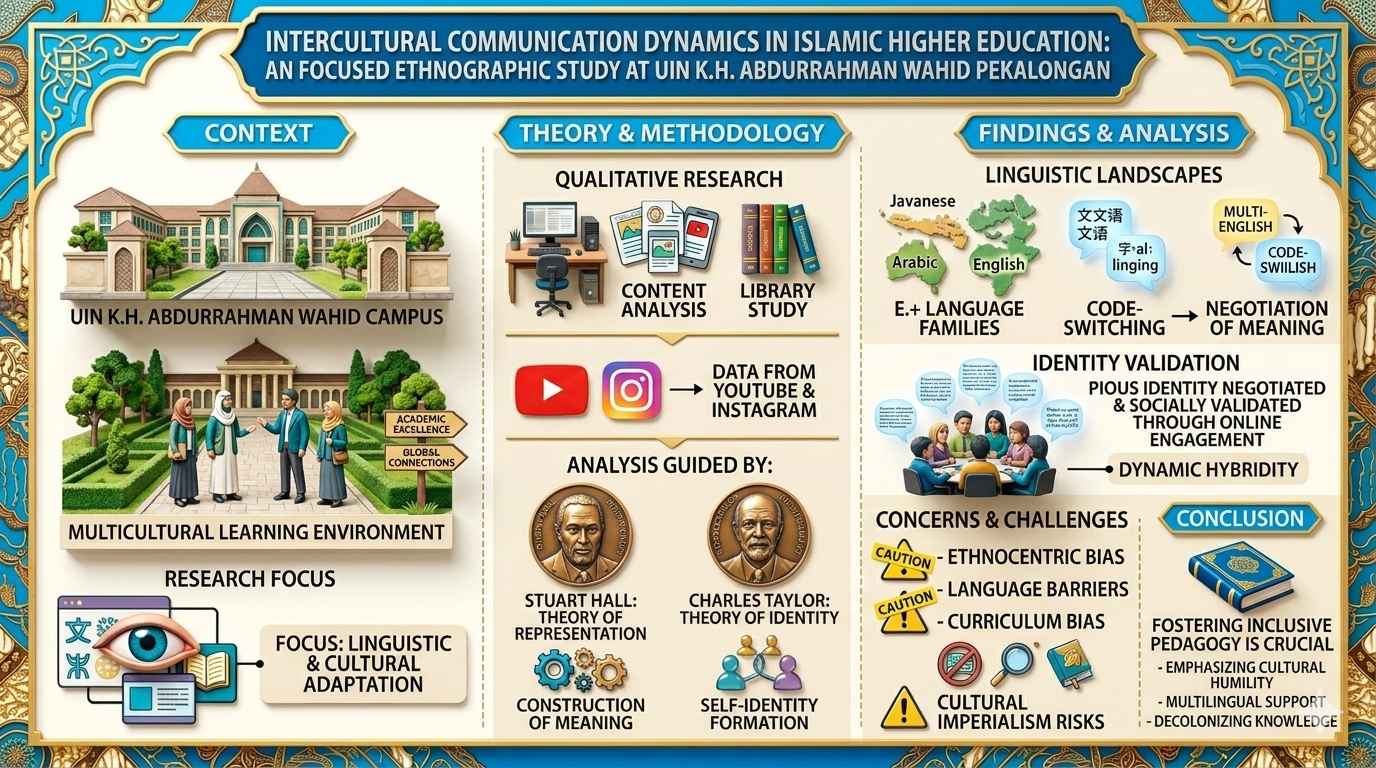
This study explores the dynamics of communication and learning between local and international students in a multicultural classroom at UIN K.H. Abdurrahman Wahid Pekalongan. The research was conducted to understand how linguistic differences, cultural background, and classroom interaction patterns shape learning experiences in an Islamic higher education context. Using a qualitative educational ethnography design, data were collected through participant observation and in-depth interviews with both local and international students who interacted intensively in the same class. The findings reveal that language is the primary factor influencing comprehension and participation, with international students experiencing significant challenges when Indonesian is used as the medium of instruction. Despite these barriers, communication remains effective through bilingual discussions, clarification strategies, and peer support. The class environment, characterized by open discussions, presentations, and supportive responses from lecturers and peers, fosters a sense of inclusion for all students. The study concludes that communication dynamics in this multicultural classroom operate positively, as students adopt adaptive linguistic strategies and collaborative learning practices that enable them to overcome cultural and linguistic differences. These dynamics generate an inclusive learning environment that benefits both local and international students.
Downloads
References
Ahmed, S. (2024). Sustained observation in short-term ethnographic research. Qualitative Inquiry, 30(2), 215–230. https://doi.org/10.1177/10778004231234567
Anfas, M. T., Retnaningdyah, P., & Munir, A. (2023). The international students’ experiences of their intercultural communication competence in Indonesia. EDUKASIA: Jurnal Pendidikan Dan Pembelajaran, 4(2), 2697–2706. https://doi.org/10.62775/edukasia.v4i2.654
Badri, R. A. R., El Karimah, K., & Sunarya, Y. D. R. (2024). Adaptasi lintas budaya mahasiswa Indonesia di lingkungan perguruan tinggi Taiwan. Filosofi: Publikasi Ilmu Komunikasi, Desain, Seni Budaya, 1(4), 1–15. https://doi.org/10.62383/filosofi.v1i4.257
Berger, Peter L., and Thomas Luckmann, The Social Construction of Reality (New York: Anchor Books, 1966)
Fa’atin, Siti, Fathur Syukur, Ahmad Rohman, and Ayu Primarni, ‘Nurturing Students’ Spirituality through Holistic Instructional Communication Implementation: A Case Study from Indonesian Islamic Higher Education’, Edukasia: Jurnal Penelitian Pendidikan Islam, 16.1 (2025), 45–59 https://doi.org/10.21043/edukasia.v16i1.30883
Gudykunst, William B., Cross-Cultural and Intercultural Communication (Thousand Oaks, CA: Sage Publications, 2003)
Itasari, A. A. (2023). Intercultural communication of Nusantara module students at Slamet Riyadi University. Formosa Journal of Applied Sciences, 2(5), Article 3964. https://doi.org/10.55927/fjas.v2i5.3964
Jidan Ramadhan, D., Saputra, N., Setiawan, A., & Mubarok, I. (2023). Strategi manajemen komunikasi dalam menghadapi tantangan multikulturalisme dalam konteks Islam. Student Research Journal, 1(6), 240–248. https://doi.org/10.55606/srjyappi.v1i6.841
Kim, Young Yun, ‘Communication and Cross-Cultural Adaptation of International Students’, International Journal of Intercultural Relations, 67 (2017), 34–45 https://doi.org/10.1016/j.ijintrel.2018.08.002
Lloyd, R. (2024). Contextual member checking in rapid qualitative studies. International Journal of Qualitative Methods, 23(1), 1–12. https://doi.org/10.1177/16094069241234500
Maulani, Hikmah, Mohamad Erihadiana, and Uus Ruswandi. “Cross-Cultural Education Model Through Multicultural Classrooms: An Ethnographic Study in Secondary Schools.” Jurnal Paedagogy, 2024: 1–18.
Mead, George Herbert, Mind, Self, and Society (Chicago: University of Chicago Press, 1934)
Qulub, Muhammad Farihul, and Roosi Rusmawati. “Navigating Intercultural Communication: Challenges Faced by International Students.” Deskripsi Bahasa, 2023: 12–29. https://doi.org/10.22146/db.18421
Safi, A. Q., Dida, S., Kayen, H. S., & Shafiq, K. (2022). Intercultural communication between Indonesian and international students at Universitas Padjadjaran. Jurnal Manajemen Komunikasi, 7(1), 55–72. https://doi.org/10.24198/jmk.v7i1.41147
Safi, Abdul Qadir, Sholih Dida, Husen S. Kayen, and Khalid Shafiq, ‘Intercultural Communication between Indonesian and International Students at Universitas Padjadjaran’, Jurnal Manajemen Komunikasi, 7.1 (2022), 33–45 https://doi.org/10.24198/jmk.v7i1.41147
Setiawan, Eko, Muhammad Chatamallah, and Wikan A. Wiksana, ‘The Meaning of Cross-Cultural Communication Experience of International Students on Pesantren-Based Campuses’, Jurnal Komunikasi, 19.1 (2024), 77–89 https://doi.org/10.20885/komunikasi.vol19.iss1.art8
Simanjuntak, Marudut Bernadtua, Zuriyati Zuriyati, and Sintowati Rini Utami. “Interaction in Literature Learning: An Ethnographic Study in Jakarta – Bataknese Cultural Perspectives.” Proceedings of the 4th International Conference on Science Education in The Industrial Revolution 4.0 (ICONSEIR 2022), 2023: 157–176. https://doi.org/10.4108/eai.24-11-2022.2332634
Subedi, D. (2023). Revisiting thick description in contemporary qualitative research. Qualitative Research Journal, 23(4), 410–425. https://doi.org/10.1108/QRJ-03-2023-0045
Toni, R. Y., Ananda, R. P., & Ayuh, E. (2023). Membangun komunikasi interkultural melalui pertukaran budaya tradisional Indonesia-Thailand. JIMAKUKERTA: Jurnal Ilmiah Mahasiswa Kuliah Kerja Nyata, 3(3), Article 6173. https://doi.org/10.36085/jimakukerta.v3i3.6173
Tsalisa, Y., & Alisaida, D. (2025). Strategi komunikasi interkultural mahasiswa asing dan lokal di UIN K.H. Abdurrahman Wahid Pekalongan. Jurnal Penelitian Ilmiah INTAJ, 9(1), 124–141. https://doi.org/10.35897/intaj.v9i1.1790
Valentina, Tri Febrianti, Yudhi Arifani, and Khoirul Anwar. “Can Digital Literacy Practices Motivate International Students To Upgrade Their English As A Second Language (L2)? : An Ethnography Case Study.” Academic Journal Perspective : Education, Language, and Literature, 9.2 (2022): 99–115. https://doi.org/10.33603/perspective.v9i2.6085
Vidyarini, T. N. (2024). Adaptasi budaya oleh mahasiswa internasional: Perspektif komunikasi lintas budaya. Scriptura, 7(2), 71–79. https://doi.org/10.9744/scriptura.7.2.71-79
Wahyudi, Sigit J., Agus N. Rahmanto, and Isrun Naini A. M., ‘Intercultural Communication Strategy of International Student Services Staff at Higher Education in Indonesia’, in Proceedings of the 2nd International Conference on Social Sciences (ICONESS 2023), 77–79 (EAI, 2023) https://doi.org/10.4108/eai.22-7-2023.2335460
Wibawa, R., Sumarwan, E., Cahyani, T. A., & Bodiman, B. (2023). Komunikasi antarbudaya mahasiswa dalam mewujudkan keharmonisan di lingkungan kampus. COMMUNITY: Jurnal Pengabdian Kepada Masyarakat, 3(2), Article 2728. https://doi.org/10.51878/community.v3i2.2728
Yasnita, Y., Hakam, A., Tertia, C. P., & Tarigan, A. R. (2025). Empathetic communication: A new paradigm in classroom management. Jurnal Civics: Media Kajian Kewarganegaraan, 22(2), 447–460. https://doi.org/10.21831/jc.v22i2.85935
Younas, A., Ahmed, O., Sattar, A., & Ali, N. (2023). The role of thick description in enhancing transferability. Nursing Inquiry, 31(1), e12501. https://doi.org/10.1111/nin.12501
Zulkifli, Norfarahi, Mohd Isa Hamzah, and Khadijah Abdul Razak, ‘Creative Teaching Practice among Islamic Education Lecturers: The Influence of Gender, Age, and Teaching Experience’, Jurnal Cakrawala Pendidikan, 41.2 (2022), 416–424 https://doi.org/10.21831/cp.v41i2.42039
Published
How to Cite
Issue
Section
License
Copyright (c) 2025 roisna kamila, Nur Khotimah, Ahmad Isa Abdallah, Tegar Dwi Wibowo

This work is licensed under a Creative Commons Attribution-ShareAlike 4.0 International License.