Representation of Urban Sufism in Constructing Urban Muslim Piety in Digital Media
DOI:
https://doi.org/10.61815/alibrah.v10i2.779Keywords:
urban Sufism, digital religion, religious identity, representation, social mediaAbstract
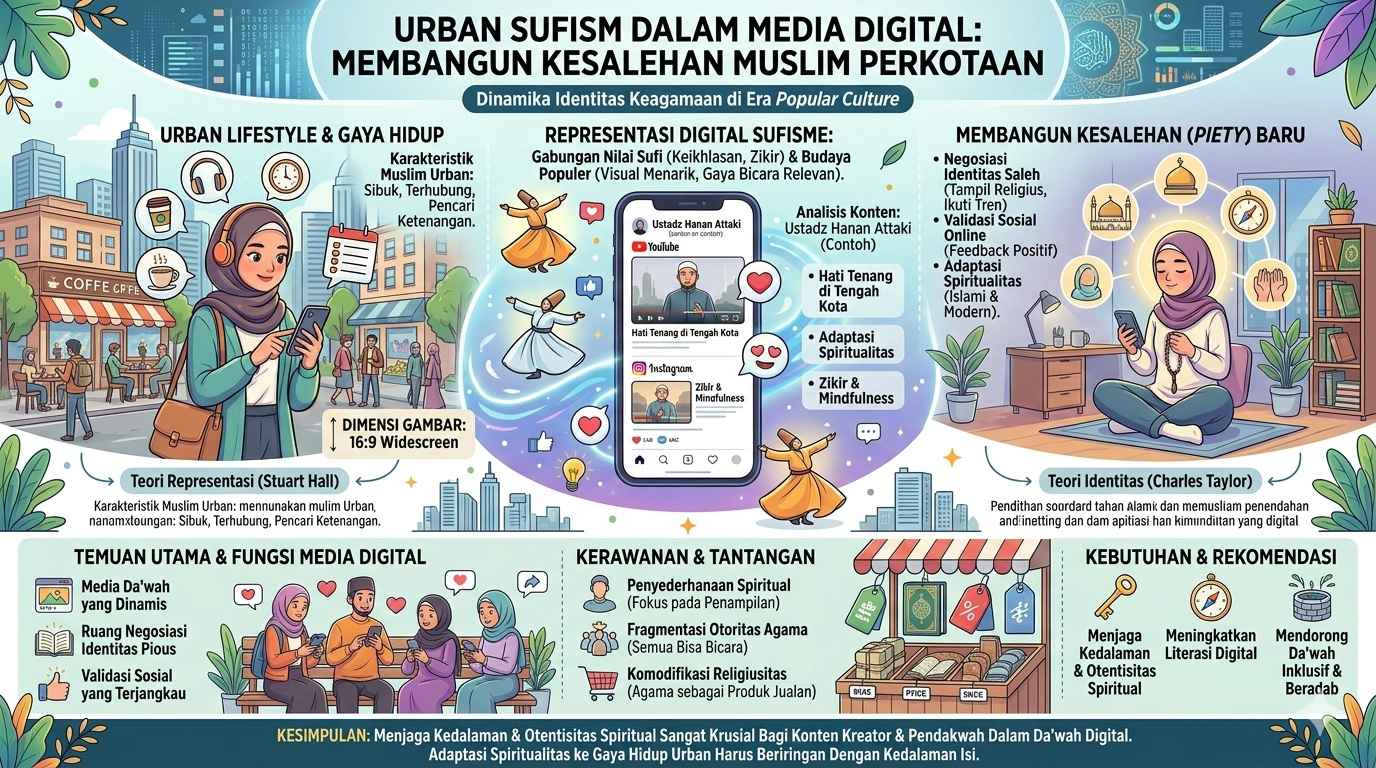
In recent years, social media has become an important arena for expressing religious identity, including the emergence of digital Sufism among urban Muslims. This study examines how urban Sufism is represented in digital media that blends Sufi values with elements of popular culture, addressing the limited scholarly attention toward its role in shaping contemporary religious identity. This qualitative research employs content analysis and library study, drawing data from YouTube and Instagram. The analysis is guided by Stuart Hall’s theory of representation and Charles Taylor’s theory of identity. The findings show that digital representations of urban Sufism function not only as a medium of da‘wah but also as a dynamic space where pious identity is negotiated and socially validated through online engagement. These representations illustrate how Islamic spirituality adapts to urban lifestyles while interacting with global popular culture. However, the phenomenon also raises concerns such as spiritual simplification, authority fragmentation, and the commodification of religiosity. The study concludes that maintaining authenticity and spiritual depth is crucial for content creators and preachers in utilizing digital platforms for inclusive da‘wah.
Downloads
References
Akmaliah, Wahyudi. “When Islamism and Pop Culture Meet: A Political Framing of the Movie ‘212: The Power of Love.’’ Studia Islamika 27, no. 1 (2020): 1–33. https://studiaislamika.ppimcensis.or.id/index.php/studia-islamika/article/view/9205?articlesBySimilarityPage=6
Aljabar Media. “Berharap & Bergantung Hanya pada Allah – Ust. Hanan Attaki Dakwah Motivasi Penyemangat.” YouTube video, March 5, 2024. https://youtu.be/ciVVaLQOfPM
Anwar, Khairil, Surawan Surawan, and Sarimah Awang. “Social Media and Religiosity: Shifting the Lifestyle Paradigm of Urban Muslim Students.” Akademika: Jurnal Pemikiran Islam 29, no. 2 (2024): 195–204. https://doi.org/10.32332/akademika.v29i2.9181
Arifin, Achmad Zainal. “From Magics, Dances, to Cafés: The Role of Sufism in Constructing Identity among the Urban Youth.” In Proceedings of the 1st Annual International Conference on Social Sciences and Humanities (AICOSH 2019), 33: 166–169. Atlantis Press, 2019. https://doi.org/10.2991/aicosh-19.2019.35
Attaki, Hanan. “Kadang takdir terasa berat banget, tapi percayalah, ….” Instagram post, September 25, 2024. https://www.instagram.com/p/DEy93S4yLqX/
Bogdan, Robert, and Sari Knopp Biklen. Qualitative Research for Education: An Introduction to Theories and Methods. 5th ed. Boston: Pearson, 2007.
Bowen, Glenn A. “Document Analysis as a Qualitative Research Method.” Qualitative Research Journal 9, no. 2 (2009): 27–40. https://doi.org/10.3316/QRJ0902027
Campbell, Heidi A., and Ruth Tsuria, eds., Digital Religion: Understanding Religious Practice in Digital Media. London: Routledge, 2021.
Creswell, John W. Qualitative Inquiry and Research Design: Choosing Among Five Approaches. 3rd ed. Thousand Oaks, CA: SAGE, 2013.
Dwifatma, Andina. “YouTube Islamic Web Series and Mediatized Piety among Urban Muslims in Indonesia.” In Trending Islam: Cases from Southeast Asia, 183–197. Singapore: ISEAS–Yusof Ishak Institute, 2023.
Fachmi, Teguh, and Fauzan Nazil Ramadhan. “What Drives Indonesian Muslim Youth Express Their Piety on Social Media: Do Psychological, Socio-Cultural, and Politics Interfere?” In Proceeding of Annual International Conference on Islamic Education and Language (AICIEL), 409–416, 2024. https://ftk.uinbanten.ac.id/journals/index.php/aiciel/article/view/10678
Hall, Stuart. Representation: Cultural Representations and Signifying Practices. London: SAGE, 1997.
Haq, Syamsul. “Piety and Commercialization Da’wah: The Influence of Hanan Attaki’s Kajian on Young Urban Muslims in Indonesia.” Al-Misbah (Jurnal Islamic Studies) 12, no. 1 (2024): 18–31. https://doi.org/10.26555/almisbah.v12i1.9951
Hidayat, Ziaulhaq. “Transforming Sufism into Digital Media: Eshaykh and Simplification of Tarekat Orthodoxy.” Epistemé: Jurnal Pengembangan Ilmu Keislaman 17, no. 2 (2022): 197–223. https://doi.org/10.21274/epis.2022.17.2.197-223
Husein, Fatimah, and Martin Slama. “Online Piety and Its Discontent: Revisiting Islamic Anxieties on Indonesian Social Media.” Indonesia and the Malay World 46, no. 134 (2018): 80–93. https://doi.org/10.1080/13639811.2018.1415056
Jaenuri, Jaenuri. “Urban Sufism: The Dynamic of Cosmopolitan Religious Community.” Teosofia: Indonesian Journal of Islamic Mysticism 11, no. 2 (2022). https://doi.org/10.21580/tos.v11i2.14303
Jannah, Raudotul, and Sholahuddin Al Ayubi. “Negotiating Ideal Piety in Digital Age: A Mixed-Methods Study on Muslim Cyber Ethics in Indonesia.” Komunike: Jurnal Komunikasi Penyiaran Islam 17, no. 1 (2025): 115–138. https://doi.org/10.20414/jurkom.v17i1.13904
Khadijah, Siti. “Commodification of Religion and Islamic Cultural Industry through Social Media.” IPERCOP: Islamic Perspective on Communication and Psychology 2, no. 1 (2025): 46–55. https://doi.org/10.61511/ipercop.v2i1.2025.1644
Kusumalestari, Ratri Rizki. “Hijrahtainment: Composing Piety and Profane as Commodification of Religion by Media.” Mediator 13, no. 2 (2020): 290–306. https://doi.org/10.29313/mediator.v13i2.6610
Makhasin, Luthfi. “Urban Sufism, Media and Religious Change in Indonesia.” Ijtima’iyya: Journal of Muslim Society 1, no. 1 (2016): 23–36. https://ejournal.uinsaizu.ac.id/index.php/ijtimaiyya/article/view/925
Miles, Matthew B., A. Michael Huberman, and Johnny Saldaña. Qualitative Data Analysis: A Methods Sourcebook. 3rd ed. Thousand Oaks, CA: SAGE, 2014.
Millie, Julian. Hearing Allah’s Call: Preaching and Performance in Indonesian Islam. Ithaca, NY: Cornell University Press, 2017.
Millie, Julian, and Emma Baulch. 2024. “Beyond the Middle Classes, Beyond New Media: The Politics of Islamic Consumerism in Indonesia.” Asian Studies Review 48, no. 1 (2024): 1–18. https://doi.org/10.1080/10357823.2023.2291103
Nuraeni, Heni Ani, and Novie Kurniasih. “The Role of Social Media Da’wah in Improving Individual Piety during the COVID-19 Pandemic.” Ilmu Dakwah: Academic Journal for Homiletic Studies 15, no. 2 (2021): 343–364. https://doi.org/10.15575/idajhs.v15i2.15734
Patton, Michael Quinn. Qualitative Research & Evaluation Methods. 4th ed. Thousand Oaks, CA: SAGE, 2015.
Pratiwi, Dinda Ayu, Diniyah Khoerunnisa Alifiyah, Qinwan Nishrina Nurul Bayani, Raden Khayla Fadhilla Azzahra Firmansyah, and Asep Rudi Nurjaman. “The Commercialization of Da’wah: An Islamic Perspective.” Hunafa: Jurnal Studia Islamika 22, no. 1 (2025): 33–46. https://www.jurnalhunafa.org/index.php/jsi/article/view/828
Raya, Moch. Khafidz Fuad. “Digital Islam: New Space for Authority and Religious Commodification among Islamic Preachers in Contemporary Indonesia.” Contemporary Islam 19, no. 1 (2024): 161–194. https://doi.org/10.1007/s11562-024-00570-z
Rosfiyanti, Nina, Nur Wahidin, and Mulawarman Hannase. “The Transformation of Urban Tasawuf in Indonesia: Cybermedia and the Emergence of Digital Religion.” Jurnal Pemikiran Islam 4, no. 2 (2024): 117–128. https://doi.org/10.22373/jpi.v4i2.24073
Rubaidi, Rubaidi. “Kontekstualisasi Sufisme bagi Masyarakat Urban.” Jurnal Theologia 30, no. 1 (2019): 127–152. https://doi.org/10.21580/teo.2019.30.1.3145
Santang, Ahmad Kintang, and Benni Setiawan. “Sufism and Social Media: Correlation between WhatsApp Usage and the Level of Religiosity of PP Jagad Alif Students.” Informasi 55, no. 1 (2025): 86–93. https://jurnal.uny.ac.id/index.php/informasi/article/view/79253
Saputra, Eko, Dony Arung Triantoro, and Ardiansyah. “Urban Muslim Youth, Pengajian Communities and Social Media: Fragmentation of Religious Authorities in Indonesia.” Al-Qalam 27, no. 2 (2021): 335–346. https://doi.org/10.31969/alq.v27i2.1004
Siregar, Eva Anzani, Mufida Tullaili, and Zul Afdal. “Social Media on Islamic Lifestyle Trends: A Systematic Review.” Indonesian Interdisciplinary Journal of Sharia Economics 8, no. 1 (2025): 2270–2286. https://e-journal.uac.ac.id/index.php/iijse/article/view/6167
Sirun, Akhmad Kastalani, and Surawan Surawan. 2025. “Konsumsi Konten Dakwah Digital dan Kesejahteraan Spiritual Mahasiswa: Kajian Empiris di Kalangan Generasi Z.” Indonesian Journal of Islamic Studies 1, no. 2: 220–226. https://doi.org/10.62567/ijis.v1i2.905
Slama, Martin, and Bart Barendregt. “Online Publics in Muslim Southeast Asia: In between Religious Politics and Popular Pious Practices.” Asiascape: Digital Asia 5, nos. 1–2 (2018): 3–31. https://doi.org/10.1163/22142312-12340090
Taufik, Zulfan, and Muhammad Taufik. “Mediated Tarekat Qadiriyah Wa Naqshabandiyah in the Digital Era: An Ethnographic Overview.” Esensia: Jurnal Ilmu-Ilmu Ushuluddin 22, no. 1 (2021): 35–43. https://doi.org/10.14421/esensia.v22i1.2511
Taylor, Charles. Sources of the Self: The Making of the Modern Identity. Cambridge, MA: Harvard University Press, 1989.
Wijaya, Wijaya, Abdillah Rofiif Fatin Ritonga, Amin Zaki, and Ahmed Hossam. “The Integration of Sufism in Contemporary Indonesian Islam: The Case of Urban and Rural Communities.” Islamic Studies in the World 2, no. 1 (2025): 42–51. https://journal.ypidathu.or.id/index.php/islamicstudies/article/view/2121
Zaid, Bouziane, Jana Fedtke, Don Donghee Shin, Abdelmalek El Kadoussi, and Mohammed Ibahrine. “Digital Islam and Muslim Millennials: How Social Media Influencers Reimagine Religious Authority and Islamic Practices.” Religions 13, no. 4 (2022): 335. https://doi.org/10.3390/rel13040335
Published
How to Cite
Issue
Section
License
Copyright (c) 2025 Diar Mukti Asri, Raysha Ramadhani, Surawan Surawan

This work is licensed under a Creative Commons Attribution-ShareAlike 4.0 International License.