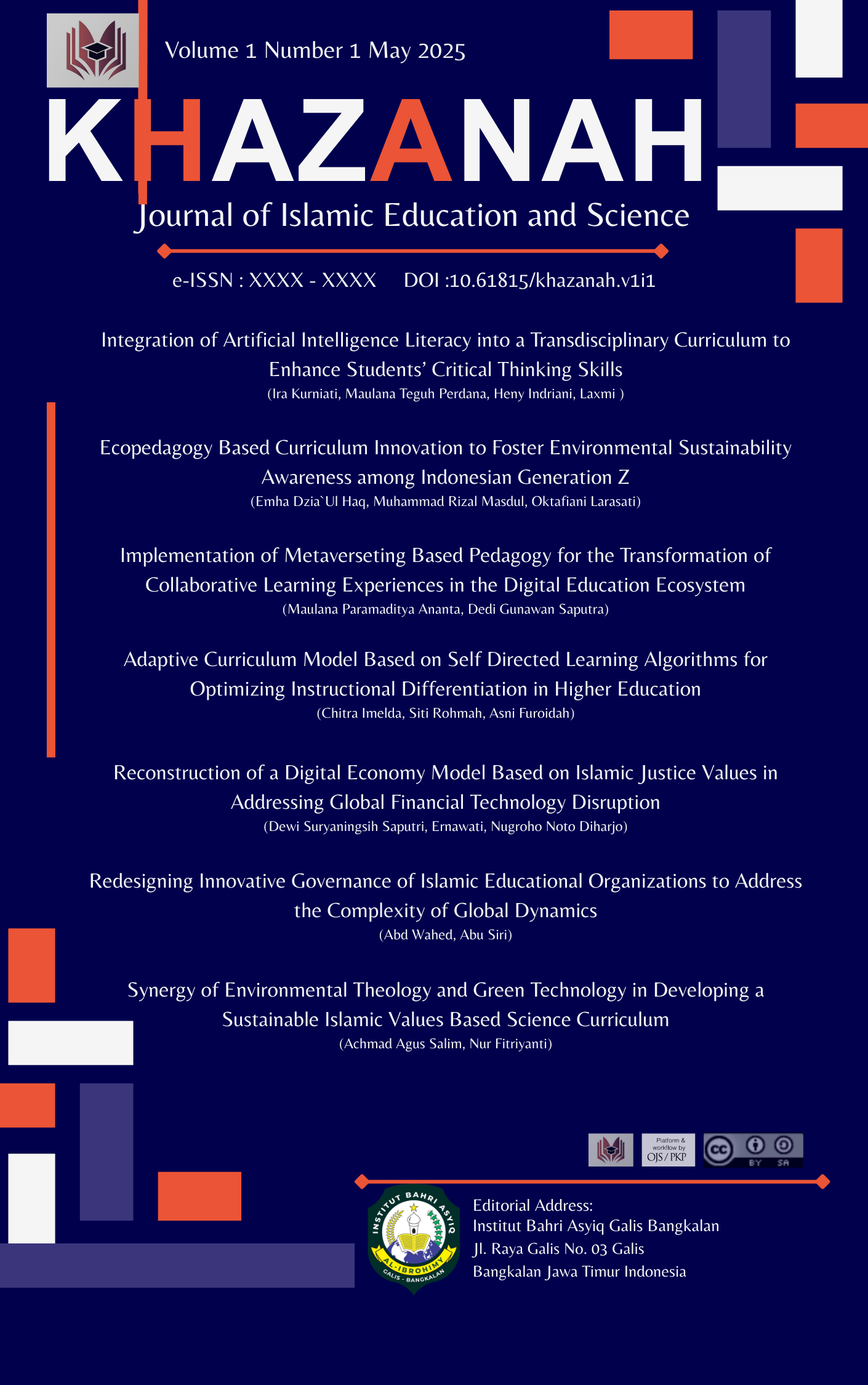
Synergy of Environmental Theology and Green Technology in Developing a Sustainable Islamic Values Based Science Curriculum
Article Sidebar
Main Article Content
Abstract
The global ecological crisis and the rapid advancement of green technology have required the reconstruction of science curricula that are not only technologically oriented but also grounded in ethical and spiritual values. In the context of Islamic higher education, the integration of environmental theology and green technological innovation has not been systematically developed within curricular structures. This study aimed to analyze and formulate a conceptual framework for the synergy between environmental theology and green technology in developing a sustainable Islamic values based science curriculum. The research employed a descriptive qualitative approach using a meta-analytic method based on thematic synthesis of scientific literature published between 2016 and 2025, retrieved from the Scopus, Google Scholar, and Sinta databases. Data were collected through systematic digital documentation and analyzed using content analysis and thematic analysis. The findings indicated that the principles of tawhid, khalifah, amanah, and ecological balance functioned as epistemological foundations in framing the ethical application of green technology. A transdisciplinary curriculum model based on green technology projects was identified as the most promising approach for strengthening students’ sustainability competencies. This study contributed to the development of an integrative science curriculum model that bridges theological and technological dimensions in Islamic higher education.
Downloads
Article Details

This work is licensed under a Creative Commons Attribution-ShareAlike 4.0 International License.
This journal applies the Creative Commons Attribution-ShareAlike 4.0 International License (CC BY-SA 4.0). Authors retain copyright and grant the journal the right of first publication. Under this license, others may copy, redistribute, remix, transform, and build upon the material for any purpose, even commercially, provided that appropriate credit is given to the original author(s) and source, and any derivative works are distributed under the same license.




References
Ardoin, N. M., Bowers, A. W., & Gaillard, E. (2020). Environmental education outcomes for conservation: A systematic review. Biological Conservation, 241, 108224. https://doi.org/10.1016/j.biocon.2019.108224
Bagir, Z. A., & Martiam, N. (2020). Religion and environmental governance in Indonesia. Worldviews: Global Religions, Culture, and Ecology, 24(1), 1–20. https://doi.org/10.1163/15685357-02401001
Berkowitz, A. R., Ford, M. E., & Brewer, C. A. (2020). A framework for integrating ecological literacy, civics literacy, and environmental citizenship. Frontiers in Education, 5, 41. https://doi.org/10.3389/feduc.2020.00041
Foltz, R. C. (2017). Islam and ecology: A bestowed trust. Harvard University Press.
Hayati, A., Ahyar, A. S., & Zulhanannan. (2025). Pengembangan kurikulum pendidikan lingkungan perspektif Islam dalam pendidikan agama Islam: A systematic literature review. Pendas: Jurnal Ilmiah Pendidikan Dasar, 10(1), 115–132.
Intergovernmental Panel on Climate Change. (2023). Climate change 2023: Synthesis report. IPCC.
Leal Filho, W., Shiel, C., & Paço, A. (2018). Implementing and operationalising integrative approaches to sustainability in higher education: The role of project-oriented learning. Journal of Cleaner Production, 172, 126–135. https://doi.org/10.1016/j.jclepro.2016.05.079
Markard, J., Raven, R., & Truffer, B. (2016). Sustainability transitions: An emerging field of research and its prospects. Research Policy, 45(6), 955–967. https://doi.org/10.1016/j.respol.2016.01.016
Nasr, S. H. (2016). Islam and the environmental crisis. Kazi Publications.
Sterling, S. (2017). A commentary on education and sustainable development goals. Journal of Education for Sustainable Development, 11(2), 208–213. https://doi.org/10.1177/0973408218781925
Tilbury, D. (2019). Education for sustainable development: A transformative learning approach. Sustainability, 11(21), 6015. https://doi.org/10.3390/su11216015
United Nations Environment Programme. (2024). Global environment outlook 6: Healthy planet, healthy people. UNEP.
Wals, A. E. J. (2019). Sustainability-oriented learning in higher education: A transdisciplinary perspective. International Journal of Sustainability in Higher Education, 20(4), 711–730. https://doi.org/10.1108/IJSHE-12-2018-0228
Wals, A. E. J., & Benavot, A. (2017). Can we meet sustainability challenges? The role of education and lifelong learning. European Journal of Education, 52(4), 404–413. https://doi.org/10.1111/ejed.12250