
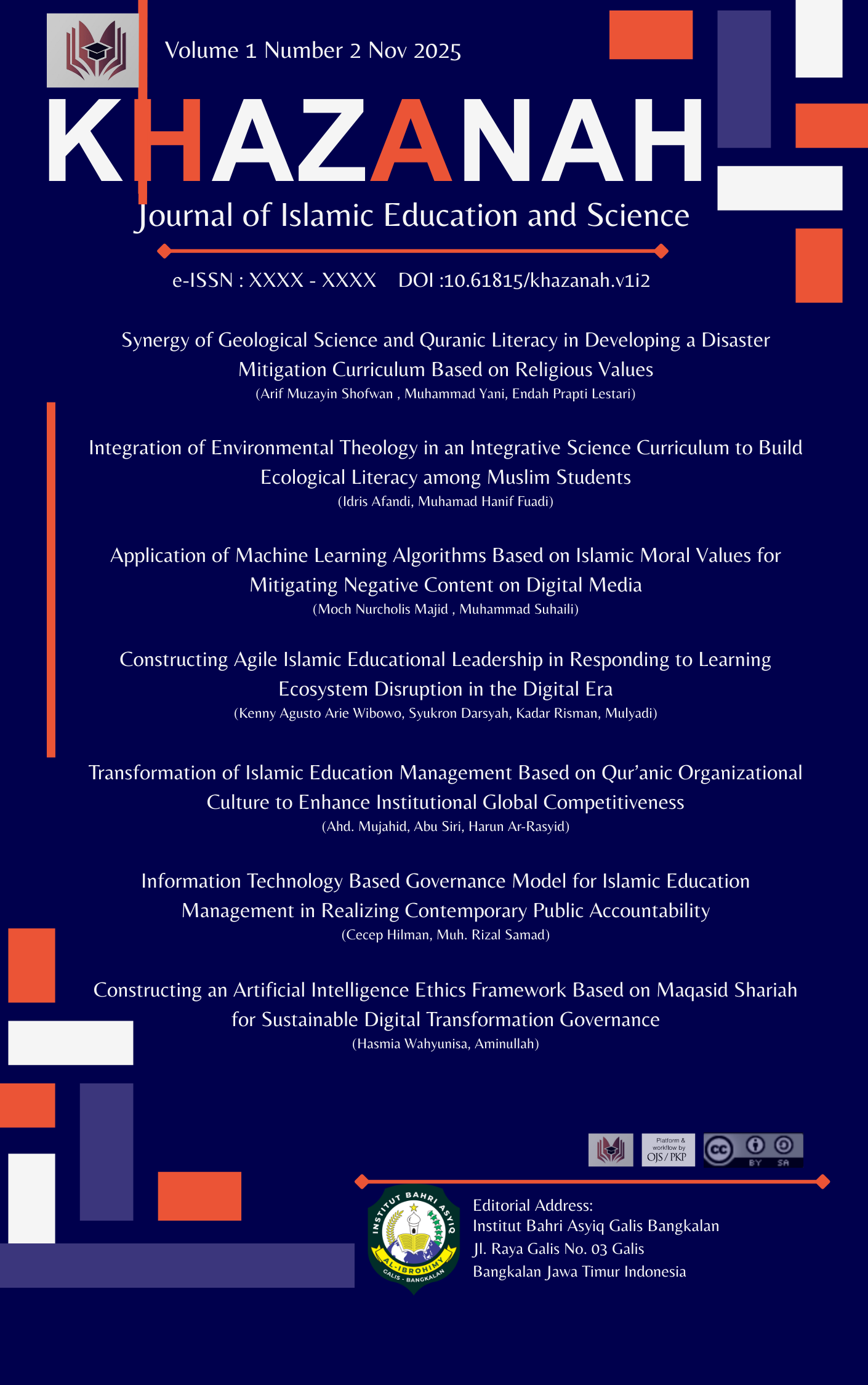
Constructing Agile Islamic Educational Leadership in Responding to Learning Ecosystem Disruption in the Digital Era
Article Sidebar
Main Article Content
Abstract
The disruption of learning ecosystems in the digital era has fundamentally restructured interaction patterns, organizational structures, and pedagogical practices within educational institutions, including Islamic education. Rapid digital transformation has required leadership models that are adaptive while remaining grounded in Islamic values. This study aimed to construct a conceptual framework of agile Islamic educational leadership in responding to the dynamics of digital learning disruption. The research employed a descriptive qualitative approach through a Systematic Literature Review of scientific publications from 2016 to 2025 retrieved from the Scopus, Google Scholar, and Sinta databases. Data were collected through systematic digital documentation and analyzed using content analysis and thematic analysis. The findings indicated that agile Islamic educational leadership was developed through the integration of organizational adaptability, data-driven decision making, digital collaboration, teacher capacity development, and a digital vision grounded in the principles of amanah, shura, and justice. This construction expanded the paradigm of educational leadership by integrating agility theory with Islamic values and provided practical guidance for sustainable digital transformation in Islamic educational institutions.
Downloads
Article Details

This work is licensed under a Creative Commons Attribution-ShareAlike 4.0 International License.
This journal applies the Creative Commons Attribution-ShareAlike 4.0 International License (CC BY-SA 4.0). Authors retain copyright and grant the journal the right of first publication. Under this license, others may copy, redistribute, remix, transform, and build upon the material for any purpose, even commercially, provided that appropriate credit is given to the original author(s) and source, and any derivative works are distributed under the same license.




References
Bozkurt, A., Jung, I., Xiao, J., Vladimirschi, V., Schuwer, R., Egorov, G., Lambert, S. R., Al-Freih, M., Pete, J., Olcott, D., Jr., Rodes, V., Aranciaga, I., Bali, M., Alvarez, A. V., Roberts, J., Pazurek, A., Raffaghelli, J. E., Panagiotou, N., de Coëtlogon, P., … Paskevicius, M. (2020). A global outlook to the interruption of education due to COVID-19 pandemic: Navigating in a time of uncertainty and crisis. Asian Journal of Distance Education, 15(1), 1–126.
Bush, T. (2017). Educational leadership and management in Islam: Theory and practice. Educational Management Administration & Leadership, 45(4), 1–15. https://doi.org/10.1177/1741143216642175
Dexter, S. (2018). The role of leadership in technology integration in schools. Educational Technology Research and Development, 66(3), 593–611. https://doi.org/10.1007/s11423-018-9586-3
Fullan, M., Quinn, J., & McEachen, J. (2020). Deep learning and digital transformation: A guide to system change. Corwin Press.
Harris, A., & Jones, M. (2020). COVID-19 – School leadership in disruptive times. School Leadership & Management, 40(4), 243–247. https://doi.org/10.1080/13632434.2020.1811479
Hodges, C., Moore, S., Lockee, B., Trust, T., & Bond, A. (2020). The difference between emergency remote teaching and online learning. Educause Review, 27, 1–12.
Ismail, R., Abdullah, A., & Hidayat, N. (2022). Digital transformation in Islamic education institutions: Leadership challenges and strategic responses. Journal of Islamic Education Studies, 10(2), 155–170.
Joiner, B., & Josephs, S. (2017). Leadership agility: Five levels of mastery for anticipating and initiating change. Jossey-Bass.
Kementerian Agama Republik Indonesia. (2023). Laporan transformasi digital madrasah tahun 2023. Direktorat Jenderal Pendidikan Islam.
Mulyono. (2021). Kepemimpinan pendidikan Islam berbasis nilai amanah dan syura dalam era digital. Jurnal Manajemen Pendidikan Islam, 6(2), 101–118.
Rahman, F., & Ahmad, S. (2023). Leadership challenges in digital Islamic schools: Adaptation and organizational resilience. International Journal of Islamic Educational Leadership, 5(1), 45–60.
Rigby, D. K., Sutherland, J., & Takeuchi, H. (2016). Embracing agile. Harvard Business Review, 94(5), 40–50.
Scherer, R., Siddiq, F., & Tondeur, J. (2021). The technology acceptance model in education: A meta-analytic structural equation modeling approach. Computers & Education, 128, 13–35. https://doi.org/10.1016/j.compedu.2018.09.009
Schleicher, A. (2018). World class: How to build a 21st-century school system. OECD Publishing.
Selwyn, N. (2022). Education and technology: Key issues and debates (3rd ed.). Bloomsbury Academic.
Tondeur, J., Aesaert, K., Prestridge, S., & Consuegra, E. (2019). A multilevel analysis of teacher digital competence. Computers & Education, 136, 1–16. https://doi.org/10.1016/j.compedu.2019.02.016
UNESCO. (2021). Reimagining our futures together: A new social contract for education. UNESCO Publishing.